
Generic dog care advice misses the point. The health problems your dog is most likely to face are written in their breed — and knowing them changes everything about how you care for them.
Thrygor Editorial Team Breeds and Curiosities · 2026
In Part 1 of this series, we covered the five subtle signs that your dog may need more care than you’re currently giving them. This second part goes deeper: why breed matters more than most owners realize, what the most popular breeds are specifically prone to, and how to build a care routine that actually matches your dog’s genetic profile.
Here’s a truth that veterinarians know well but rarely have time to fully explain during a 15-minute appointment: your dog’s breed is the single most predictive factor for their long-term health risks. More than diet. More than lifestyle. More than luck.
Centuries of selective breeding concentrated specific physical traits in specific breeds — and those same traits came packaged with specific vulnerabilities. The flat face that makes French Bulldogs so expressive also creates breathing problems. The long spine that gives Dachshunds their distinctive shape also makes them uniquely prone to disc herniation. The retrieving instinct that makes Labradors such great family dogs comes paired with a genetic mutation that makes them perpetually feel hungry.
Understanding your dog’s breed-specific risks isn’t about worrying more. It’s about worrying about the right things — and doing something about them before problems develop.
+60%of breed-specific conditions are preventable with early action
5×more expensive to treat advanced conditions vs early-stage
340+recognized dog breeds, each with a distinct health profile
Why Generic Dog Advice Falls Short
Walk into any pet store or scroll through any dog care website, and you’ll find the same advice repeated endlessly: feed your dog quality food, exercise them regularly, brush their teeth, take them to the vet annually. All of that is true — but it’s wildly incomplete.
Telling a Dachshund owner to “let their dog jump on and off the couch” because it’s good exercise is the same as handing someone with a peanut allergy a snack bar and saying “protein is important.” Technically correct advice applied to the wrong context becomes harmful advice.
The Breed-Risk Gap
Most dog owners don’t learn about breed-specific risks until something goes wrong. A Rottweiler owner discovers their dog has bone cancer at age seven. A Cavalier King Charles Spaniel owner learns their dog has heart disease — the breed’s leading cause of death — only after it’s already advanced. A Shih Tzu owner is surprised by chronic eye problems that are, in fact, nearly universal in the breed.
The information isn’t secret. It’s been documented by veterinary researchers for decades. The gap is in how that information reaches the people who need it — dog owners — in a format they can actually act on.
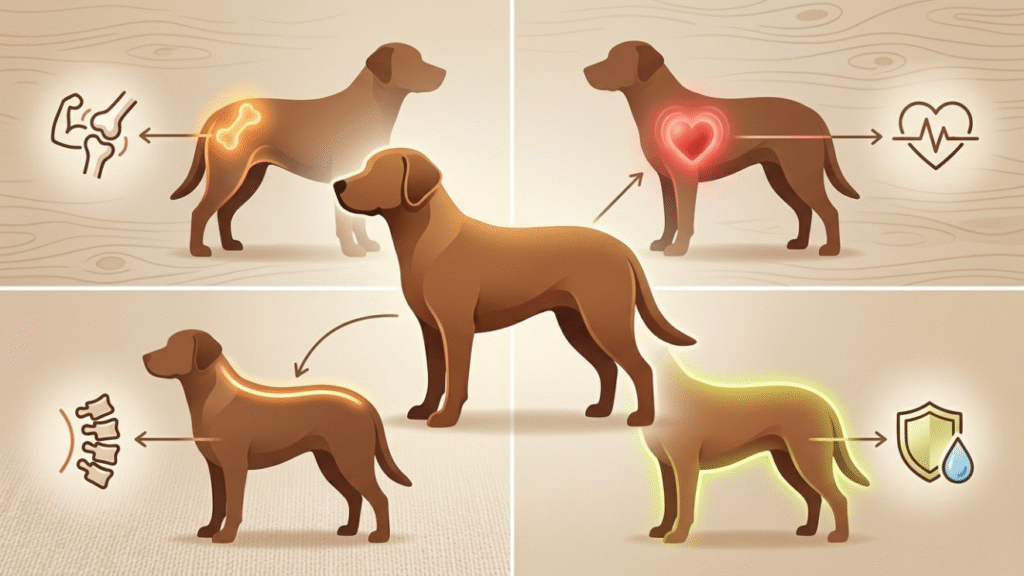
Health Profiles for the Most Popular Breeds
Below are the specific health risks for some of the most common dog breeds. This isn’t meant to alarm you — it’s meant to give you the head start that most owners don’t get until much later.
French Bulldog
Brachycephalic · High-risk breed
- Brachycephalic Obstructive Airway Syndrome (BOAS) — The compressed skull creates a permanently narrowed airway. Breathing difficulty ranges from mild to severe. Surgical correction is often necessary.
- Spinal disc disease (IVDD) — The shortened spine increases pressure on intervertebral discs. Jumping and stairs significantly raise the risk of herniation.
- Skin fold dermatitis — Moisture trapped in facial folds creates the ideal environment for bacterial and yeast infections. Daily cleaning is not optional.
- Heat intolerance — Frenchies cannot regulate body temperature effectively. Heatstroke risk is high even in moderate temperatures.
Labrador Retriever
Large breed · Obesity-prone
- Obesity (genetic) — A specific mutation in the POMC gene, found in roughly 25% of Labs, causes persistent hunger and reduced sense of fullness. Weight management must be active and intentional.
- Hip and elbow dysplasia — One of the most common orthopedic conditions in the breed. Excess weight dramatically accelerates progression. Early X-ray screening is recommended.
- Progressive retinal atrophy — A hereditary condition causing gradual vision loss, eventually leading to blindness. DNA testing can identify carriers before breeding.
- Exercise-induced collapse (EIC) — Some Labs experience sudden muscle weakness and collapse after intense exercise. Rest and monitoring are key management strategies.
Golden Retriever
Large breed · Cancer-prone
- Cancer (exceptionally high rate) — Goldens have the highest cancer rate of any breed — approximately 60% will develop some form of cancer in their lifetime. Hemangiosarcoma, lymphoma, and osteosarcoma are the most common types.
- Subvalvular aortic stenosis (SAS) — A heart defect that may be present at birth and can cause sudden death in young dogs without prior symptoms. Annual cardiac exams are essential.
- Hip dysplasia — Like Labradors, Goldens carry a high genetic risk for joint dysplasia, worsened by excess weight and high-impact activity in young dogs.
Dachshund
Long-bodied · Spine at risk
- Intervertebral disc disease (IVDD) — Dachshunds are the breed most affected by spinal disc herniation. Up to 25% will experience at least one disc event in their lifetime. Stairs, jumping, and excess weight are the three biggest avoidable risk factors.
- Obesity — Every extra gram creates direct pressure on the spine. Weight management in Dachshunds isn’t aesthetic — it’s neurological protection.
- Patellar luxation — The kneecap slips out of position, causing intermittent lameness. More common in miniature Dachshunds.
Beagle
Medium breed · Scent-driven
- Obesity — Beagles are food-motivated to an extreme degree. They will eat until they’re sick if given the opportunity. Strict portion control is non-negotiable for this breed.
- Ear infections (chronic) — The long, floppy ears trap moisture and restrict airflow, creating a perfect environment for recurring otitis. Weekly ear cleaning should be a fixed part of their care routine.
- Epilepsy — Beagles have a higher-than-average rate of idiopathic epilepsy. First seizures often occur between ages 6 months and 5 years.
- Hypothyroidism — Low thyroid hormone production, causing weight gain, lethargy, and coat changes. Managed effectively with daily medication once diagnosed.
💡 Important: This list covers only five breeds. There are hundreds of recognized breeds, each with their own specific risk profile. The principle — that breed determines risk — applies universally. If your breed isn’t listed here, the same logic applies: find out what they’re prone to, and build your prevention strategy around that.
The Problem with Remembering All of This

Reading this article gives you a foundation. But remembering specific risk factors for a specific breed, translating them into daily habits, tracking what you’ve done and what you haven’t — that’s where most owners lose the thread.
It’s not lack of care. It’s lack of a system. Dental care slides because there’s no reminder. Weight creeps up because there’s no tracking. The annual heartworm check gets pushed back because there’s no alert.
This is the gap between knowing and doing — and it’s where most preventable health problems actually develop.
What a Breed-Specific Health System Looks Like
Ideally, every dog owner would have access to something that:
- Knows their dog’s breed and maps out the specific risks automatically
- Generates a monthly health checklist based on those risks — not generic advice
- Tracks weight, vaccination dates, grooming, and other metrics over time
- Provides a way to ask breed-specific health questions and get relevant answers
- Sends reminders before things get missed, not after
This kind of personalized health management used to require either a very attentive vet or a lot of dedicated research. Today, it doesn’t.
BreedCare Pro does exactly this — free
Select your dog’s breed and get a personalized health plan, monthly checklist, breed-specific alerts, and access to a Vet AI trained on your dog’s specific risks.Try it free →
Building Your Dog’s Preventive Care Routine
Once you know your breed’s specific risks, building a preventive routine becomes much more intuitive. You’re no longer guessing — you’re addressing known vulnerabilities with known solutions.
Here’s a framework that works across most breeds. Customize it based on what you’ve learned about yours:
Daily (5 minutes)
- Observe energy level and appetite — any change from baseline is worth noting
- For brachycephalic breeds: check breathing at rest
- For long-eared breeds: quick check that ears aren’t wet or irritated
- For spinal-risk breeds (Dachshund, Corgi, Basset): no jumping on/off furniture
Weekly (10 minutes)
- Visual weight check using the rib-feel test
- Quick coat and skin inspection — part the fur in several spots
- Check eyes and ears for discharge or odor
- Dental check — look for tartar, red gums, or breath changes
- Note any changes in movement, posture, or behavior
Monthly
- Weigh your dog — on the same scale, at the same time of day
- Apply flea and tick prevention (if using monthly products)
- Review your health log — have there been recurring observations worth discussing with your vet?
Annually (or as recommended for your breed)
- Full veterinary examination, including bloodwork
- Dental cleaning if tartar has accumulated
- Hip and elbow screening for predisposed breeds (Labrador, German Shepherd, Golden Retriever)
- Cardiac evaluation for predisposed breeds (Cavalier, Boxer, Golden Retriever)
- Eye evaluation for breeds with known optic risks (Collie, Poodle, Cocker Spaniel)
📋 Breed-Specific Preventive Care Checklist
› I know my breed’s top 3 health risks
› My dog is at a healthy weight for their breed standard
› Vaccines, deworming, and flea prevention are current
› I brush their teeth at least 3x per week
› I’ve adjusted the home environment for their breed’s needs (ramps, temperature, exercise limits)
› I track their weight monthly
› My vet knows my breed’s risk profile and we have a screening schedule
Conclusion
The most effective thing you can do for your dog’s long-term health isn’t a supplement, a premium food, or an expensive gadget. It’s knowing what your specific breed is vulnerable to — and acting on that knowledge consistently, before problems develop.
The five breeds profiled in this article represent just a fraction of the full picture. Whatever breed you have, the same principle applies: their genetic heritage is the most reliable predictor of their health future. Learn it. Build around it. Stay ahead of it.
The difference between catching a hip dysplasia early at age two and discovering it at age six, already advanced, isn’t luck. It’s knowledge applied consistently over time. That’s what breed-specific care means in practice.
If there’s one thing to take from this two-part series, it’s this: your dog doesn’t need you to be a veterinarian. They need you to pay attention to the right things, consistently. Everything else follows from that.
📱 Free App
Get a Personalized Health Plan for Your Dog’s Breed
BreedCare Pro maps your dog’s breed to their specific health risks — and turns that into a monthly checklist, smart alerts, and access to a Vet AI that knows your breed inside out.
🎯 50+ breeds supported✅ Monthly health checklist🤖 Vet AI by breed📊 Weight & vaccine tracking
📲 Download Free — No signup needed
Works on iPhone and Android · Instant access
Does your dog’s breed have a health risk that caught you off guard? Share it in the comments — the more owners know about breed-specific conditions, the earlier they can act. Your experience might help another dog owner avoid a much harder situation down the road.
Free · Works on iPhone and Android · No signup required

My name is Igor Silva and I’ve been passionate about animals since childhood. I dedicate my work to sharing reliable, practical information about pet care, health, and well-being.