
You’ve probably noticed it: your favorite chair has teeth marks on the armrest, your coffee table leg is splintered, or your dog proudly trots in with one of your shoes—again. Your heart sinks. Not because of the damage, but because you’re tired of feeling frustrated, guilty, or helpless. You love your dog. You just wish they’d stop treating your home like a chew toy catalog.
You’re not alone. Destructive chewing is one of the most common—and most misunderstood—behavior issues dog owners face. But here’s what no one tells you: your dog isn’t being spiteful, stubborn, or “bad.” They’re communicating a need. And with the right approach, you can meet that need while protecting your belongings—without yelling, punishment, or broken trust.
This guide walks you through a clear, step-by-step plan to stop your dog from chewing furniture humanely. You’ll learn why it happens, how to tell if it’s boredom, anxiety, or something medical, and exactly what to do—starting today. No gimmicks. No fear-based tactics. Just practical, vet- and trainer-approved strategies that work for real life.
You Aren’t Failing—Your Dog Is Just Doing What Dogs Do
You hear it every time your dog finds something new to gnaw: the rhythmic scrape of teeth on wood, the soft rip of fabric, the quiet crunch of a baseboard corner. It’s maddening—but it’s also completely normal.
Dogs explore the world with their mouths. From puppyhood through adulthood, chewing helps them:
- Relieve teething pain (in young dogs)
- Strengthen jaw muscles
- Clean teeth naturally
- Burn off mental and physical energy
- Self-soothe during stress or uncertainty
The problem isn’t the chewing itself. The problem is what they’re chewing. And that usually comes down to three things: opportunity, lack of alternatives, and unmet needs.
If your dog has access to your couch and nothing more engaging to do, they’ll chew the couch. It’s not defiance—it’s logic. Your job isn’t to stop chewing altogether (you can’t, and shouldn’t). Your job is to redirect it to appropriate outlets while removing temptation.
Why Your Dog Chews Furniture (And Why “He’s Bored” Isn’t the Full Story)
Most advice starts and ends with “your dog is bored.” While boredom plays a role, it’s rarely the whole picture. Jumping to this conclusion leads to generic fixes—like tossing a bone in the room—that miss deeper causes.
Let’s look at the real reasons your dog might be targeting your furniture.
Teething Puppies (3–8 Months Old)
If your dog is under a year old, teething is likely the culprit. Between 3 and 8 months, puppies lose their baby teeth and grow adult ones. Their gums ache, swell, and itch. Chewing provides soothing pressure—like a human rubbing a sore tooth.
Signs it’s teething:
- Excessive drooling
- Whining while chewing
- Preference for cold or soft items
- Finding tiny teeth on the floor
What to do: Offer chilled rubber toys (freeze a Kong or wet rope toy). Avoid hard nylon or bones that could damage emerging teeth. Supervise closely—puppies can choke on small pieces.
Boredom and Lack of Mental Stimulation
Adult dogs need more than walks. They need jobs. Without mental challenges, they invent their own—like dismantling your ottoman.
Signs it’s boredom:
- Chewing happens mostly when you’re busy or away
- Your dog destroys multiple items in one session
- They ignore their current toys
- They seem restless or “on edge” indoors
What to do: Add daily brain games. Use puzzle feeders for meals. Play “find it” (hide treats under cups). Rotate toys every few days to keep novelty high. A mentally tired dog is far less likely to redecorate your living room.
Separation Anxiety or Stress
This is often mistaken for revenge. In truth, dogs with separation distress chew as a coping mechanism—a way to calm themselves when overwhelmed by your absence.
Red flags:
- Destruction occurs only when you’re gone
- Happens within 20–30 minutes of departure
- Paired with whining, pacing, house-soiling, or escape attempts
- Your dog seems clingy before you leave
What to do: Record your dog when you’re away. Practice “fake departures” (pick up keys, put on shoes—then sit down). Create a safe zone with calming music and a long-lasting chew. If symptoms persist, consult a certified behavior professional.
Hunger or Nutritional Gaps
Rare, but possible. Some dogs chew non-food items due to pica—a condition linked to nutritional deficiencies or gastrointestinal discomfort.
Signs:
- Chewing food wrappers, trash, or kitchen items
- Sudden onset of intense chewing
- Weight loss or changes in appetite
What to do: Review your dog’s diet with your vet. Ensure they’re getting enough calories and fiber for their age and activity level.
Medical Pain or Discomfort
Dogs hide pain well. Chewing can be a displacement behavior—a way to cope with discomfort they can’t express.
Possible causes:
- Dental disease (broken tooth, gum infection)
- Arthritis (chewing paws or nearby objects)
- Nausea or GI upset
When to suspect this: If chewing is new, intense, or paired with other symptoms (drooling, reluctance to eat, limping), schedule a vet visit before assuming it’s behavioral.
Step 1: Rule Out Health and Emotional Issues First
Don’t start training until you’ve ruled out medical or serious emotional causes. Punishing a dog for chewing caused by pain or anxiety only makes things worse.
Keep a Simple Behavior Journal
For one week, note:
- Time of each chewing incident
- What was chewed
- Where it happened
- What happened before (you left, storm, visitor)
- Your dog’s body language (panting, tail low, ears back)
Patterns will emerge. Example:
“Every weekday at 9:15 AM, after I leave, he chews the door frame and whines for 10 minutes.”
→ Strong sign of separation distress.
Share this with your vet or trainer. It’s far more useful than saying, “He just chews stuff.”
When to Call a Professional
Seek help if you see:
- Resource guarding: growling or stiffening when you approach a chewed item
- Compulsive behavior: repetitive licking/chewing with no trigger
- Self-injury: raw paws or broken teeth from chewing
- No improvement after 2–3 weeks of consistent management
Look for trainers certified by CCPDT-KA or behaviorists from ACVB. Avoid anyone using shock collars, alpha rolls, or “dominance” theory.
Step 2: Manage the Environment—Stop the Rehearsal
Dogs learn through repetition. Every time your dog chews the couch, they practice and reinforce that behavior. Management stops rehearsal so new habits can form.
Dog-Proof Like a Pro

Get down on all fours and scan each room from your dog’s perspective.
Remove or secure:
- Shoes, socks, laundry baskets
- Remote controls, chargers, earbuds
- Throw pillows and blankets with your scent
- Window blind cords (choking hazard)
- Trash cans (use locking lids)
- Books, kids’ toys, decor
Use baby gates to limit access. Store tempting items in closed closets.
Create a Safe Space When You Can’t Supervise
When you’re cooking, working, or sleeping, your dog needs a secure area.
Options:
- Crate: Only if your dog sees it as a den (never use as punishment)
- Exercise pen (x-pen): Great for crate-averse dogs
- Dog-proofed room: Bathroom or spare bedroom with bed, water, and toys
Make it inviting:
- Add a soft bed
- Leave a worn T-shirt with your scent
- Provide a long-lasting chew (stuffed Kong, bully stick)
- Play calming music or white noise
Start with short durations (5–10 minutes) and gradually increase as your dog relaxes.
Use Anti-Chew Sprays—But Use Them Right
Bitter sprays can help—but they’re not magic.
How to use effectively:
- Test on a small area first (some fabrics stain)
- Let your dog smell it on a cloth—don’t spray in their face
- Apply to cleaned surfaces (dirt masks the taste)
- Reapply daily for 2–4 weeks
- Always pair with redirection: offer a better chew immediately after
Note: Some dogs ignore bitter sprays. Others avoid the sprayed item but chew something else. Use as a supplement, not a solution.
Step 3: Give Better Alternatives Than Your Couch
Your sofa smells like you, feels soft, and doesn’t move. To compete, chew toys must be more rewarding.
Match Toys to Your Dog’s Style
| Chew Style | Best Toys | Avoid |
|---|---|---|
| Soft Chewer | Plush, soft rubber (Kong Puppy), rope | Hard nylon, antlers |
| Moderate Chewer | Standard Kong, West Paw Zogoflex | Rawhide, thin plastic |
| Power Chewer | GoughNuts, Kong Extreme, elk antlers | Stuffed toys, cooked bones |
⚠️ Never give cooked bones—they splinter and can cause internal injury.
Make Toys Irresistible
A dry Kong won’t compete with your leather sofa. Stuff it!
Easy stuffing ideas:
- Peanut butter + pumpkin puree (freeze overnight)
- Wet dog food + mashed banana
- Kibble + low-sodium broth (freeze for longer challenge)
Rotate toys every 3–5 days. Keep 6–8 in a closet and swap 2–3 at a time. Novelty drives interest.
Teach “Trade” Instead of “Drop It”
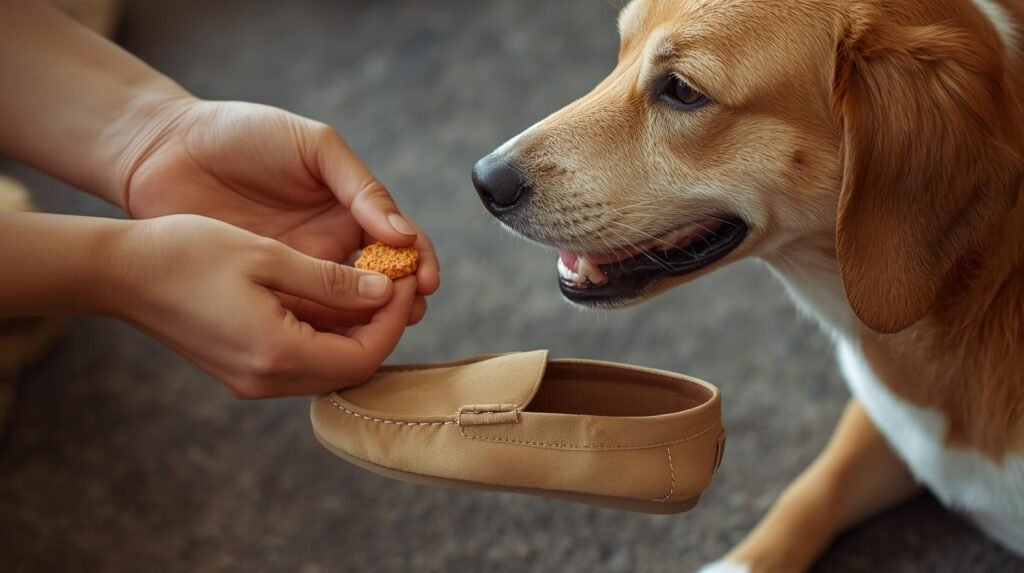
“Drop it” can feel threatening. “Trade” builds cooperation.
How to train:
- Hold a high-value treat near your dog’s nose
- Say “trade!” in a happy voice
- When they release the item, give the treat + praise
- Return the original item (if safe) to build trust
Practice with low-value items first (old towel), then progress to higher-value ones.
Step 4: Build a Daily Routine That Prevents Chewing
Consistency reduces anxiety and eliminates “empty time” when chewing thrives.
Sample Daily Schedule
| Time | Activity | Purpose |
|---|---|---|
| 7:00 AM | Walk + sniff time | Burns energy, satisfies curiosity |
| 8:00 AM | Breakfast in puzzle feeder | Mental stimulation |
| 12:00 PM | Check-in: stuffed Kong | Keeps busy during work hours |
| 5:00 PM | Play session (tug, fetch) | Bonding + impulse control |
| 7:00 PM | Training (5–10 min) | Builds focus, tires the brain |
| 8:00 PM | Wind-down chew + calm time | Prepares for sleep |
Adjust based on your dog’s age, breed, and health. Senior dogs may need shorter sessions.
Key Principles
- Exercise before confinement: A tired dog settles faster
- Mental > physical fatigue: A 10-minute puzzle game can equal a 30-minute walk
- Predictability = security: Dogs thrive on routine
What NOT to Do (Common Mistakes That Backfire)
Avoid these well-intentioned but harmful approaches:
❌ Yelling or scolding after the fact
→ Your dog won’t connect it to the chewing. They’ll only learn you’re scary.
❌ Rubbing nose in the mess
→ Causes fear, not understanding. Can lead to hiding when eliminating or chewing.
❌ Giving old shoes as toys
→ Confuses what’s allowed. Your dog can’t tell “old” vs. “new” shoes.
❌ Using punishment-based devices (shock collars, citronella sprays)
→ Increases anxiety, may worsen chewing or create new behavior problems.
FAQ: Real Questions from Real Dog Owners
Q: My dog only chews when I’m gone. Is it separation anxiety?
A: Possibly. If it’s accompanied by pacing, vocalizing, or house-soiling within 30 minutes of your departure, yes. Start with gradual desensitization and consult a professional if severe.
Q: Are rawhide chews safe?
A: Generally not recommended. They can cause choking, blockages, or contain contaminants. Choose digestible, vet-approved alternatives like yak chews or pressed rawhide-free options.
Q: How long does it take to stop destructive chewing?
A: With consistent management, most dogs show improvement in 2–4 weeks. Full resolution depends on cause—teething ends naturally; anxiety may take months of behavior work.
Q: Can I use a muzzle to prevent chewing?
A: Only under direct supervision and for short periods (e.g., vet visits). Never use a muzzle for confinement—it’s unsafe and inhumane.
Q: What if my dog chews their crate?
A: This often means the crate is too big, introduced too fast, or used during high-anxiety times. Go back to crate training basics or switch to an x-pen.
Final Thoughts: Small Steps, Big Changes
You don’t need to overhaul your life to stop destructive chewing. You just need one consistent change.
Maybe it’s putting your shoes in a closed closet tonight. Maybe it’s stuffing a Kong with peanut butter before your next Zoom call. Maybe it’s practicing “trade” with an old sock.
Each small action teaches your dog: “There’s always something better to chew than the furniture.”
And over time, that lesson sticks—not because you forced it, but because you made the right choice easy, rewarding, and kind.
Your dog isn’t giving you a hard time. They’re having a hard time. Meet them with patience, and you’ll both find peace—on the couch, not in pieces.

My name is Igor Silva and I’ve been passionate about animals since childhood. I dedicate my work to sharing reliable, practical information about pet care, health, and well-being.